
Objectives of the trials
The Exocet FlyingShape algorithm operates in real time while sailing. The test campaigns aim to support its continuous development.
As new features are developed or computational performance is improved, each version is evaluated in real-world conditions. Testing the system on different platforms also makes it possible to verify its compatibility with a variety of geometries, rigging configurations, and uses.
These trials directly contribute to the robustness of the solution by identifying edge cases and strengthening the long-term reliability of the measurements.
Conduct of sea trials
During the trials, the system is used exactly as it would be on board in normal operation.
An initial phase is required to adapt the installation to the specific characteristics of the boat (dimensions, sensor positioning, sailing environment). Once this phase is complete, processing is carried out in real time while sailing.
After sailing, certain sequences are replayed and analyzed in greater detail. This makes it possible to rework situations where measurement quality can be improved or to perform a more in-depth analysis of sail shapes.
Conditions encountered
The trials were conducted under a wide range of conditions:
- Light to strong winds, from 1 to 30 knots,
- Flat seas and rough seas,
- Varying levels of sensor integration depending on the yacht.
Each configuration makes it possible to observe the influence of wind, sea state, and boat dynamics on sail shape, and to incorporate these effects into the measurement metrics.
Data used for trimming
The system is capable of reconstructing the 3D shape of a sail from measurements. However, for trimming while sailing, this representation alone is not sufficient.
Exocet FlyingShape synthesizes the measurements into a set of directly usable metrics:
- twist and camber at 25%, 50%, and 75% of sail height,
- luff curve value,
- and many other metrics useful to sailors.
These parameters describe the sections of the sail profile and make it possible to objectify trimming adjustments. They also correspond to the quantities used by sailmakers and design teams, which facilitates exchanges between sailing, design, and post-sailing analysis.
For more in-depth analyses, additional metrics can be extracted, such as draft position or specific indicators calculated on the sail profile.
Uses depending on boat size and sailing program
The technology used is identical across all units. The same algorithm is employed, regardless of the size of the boat.
However, the way the system is used varies depending on the sailing program.
In short or highly dynamic formats, the metrics are monitored continuously, particularly during acceleration phases or rapid changes in conditions.
During longer passages, the system is used in sequences to make adjustments based on averaged values and is then switched off to limit energy consumption.
System integration is adapted according to these different use cases.
User profiles
Exocet FlyingShape data is used by the entire crew.
Trimmers rely on the metrics to adjust sails while sailing.
Engineers use the data to analyze system behavior and structure exchanges with crews and designers.
Sailmakers use the measurements to compare real sail shapes with design targets and evolve their designs.
Access to a reliable measurement of sail shape creates a shared basis for discussion among all these profiles, both on board and ashore.
“Seeing an Ultim trimaran's sails measured and reconstructed live, watching sailors and engineers react, discuss and trim using real-time shape metrics: this reminded me why we put such effort into Exocet FlyingShape exists: to turn intuition into measurable performance!”
Loughlin Dudley – co-founder of MDS
From field trials to a proven solution
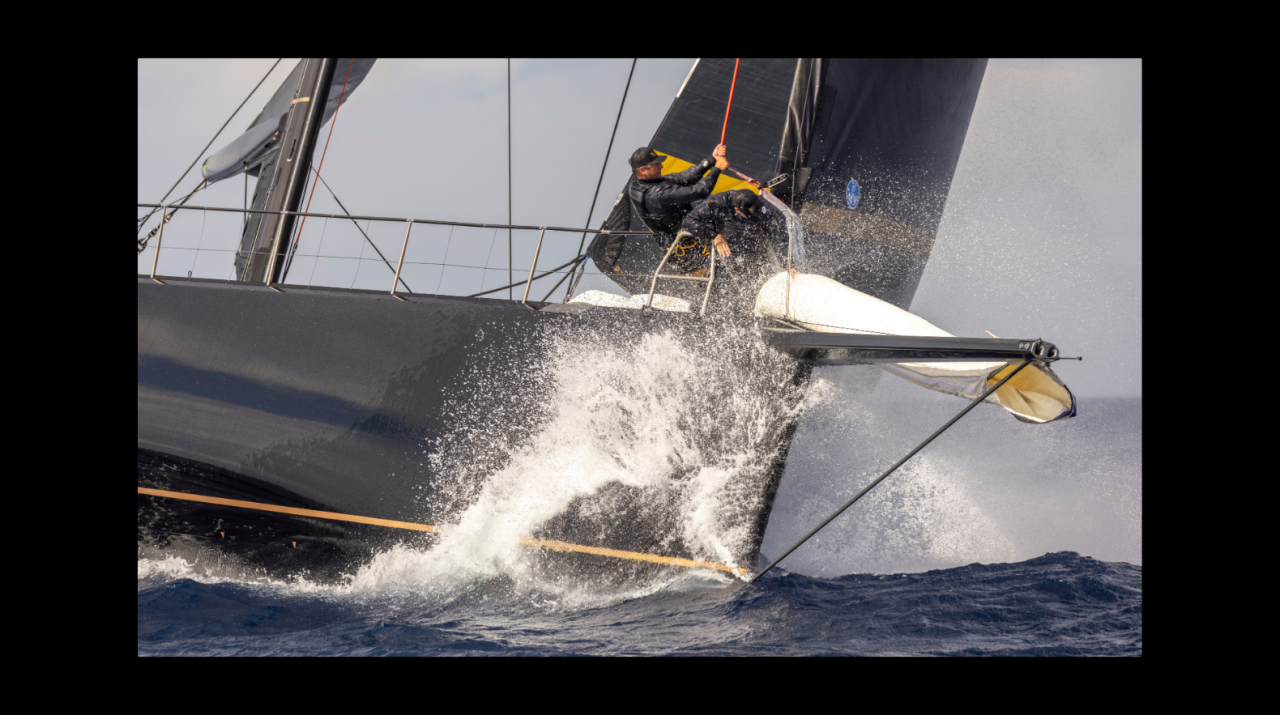
The trial campaigns conducted on units ranging from 30 to 100 feet demonstrated Exocet FlyingShape’s ability to operate reliably in real-world conditions, across very different platforms, rigging configurations, and sailing programs.
They also played a key role in the continuous improvement of the algorithms, confronting theoretical models with on-the-ground realities.
Beyond measurement alone, these tests confirmed the relevance of a tool capable of transforming the actual shape of sails into usable, understandable data shared by all project stakeholders: sailors, engineers, and sailmakers.
Exocet FlyingShape thus establishes itself as a technological building block in the service of sailing performance: a solution designed to evolve, adapt, and support teams in achieving a precise and objective understanding of their sails, both today and in future developments.
