
Orient Express Corinthian: Data Driving the Next Generation of Wind Propulsion
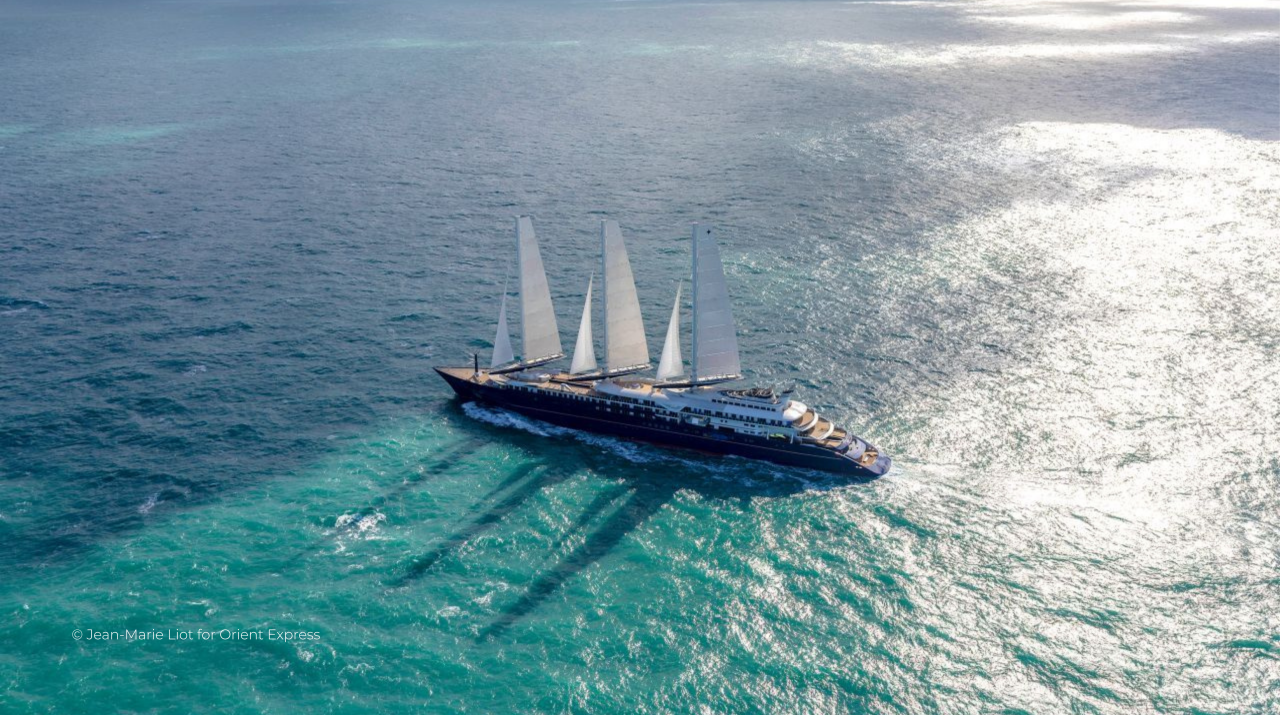
Recently launched in Saint-Nazaire, the Orient Express Corinthian embodies a new generation of vessels where technological innovation, energy performance and maritime excellence converge on an unprecedented scale. Measuring 220 metres in length and equipped with three carbon masts rising more than 100 metres above sea level, this exceptional cruise yacht developed by Chantiers de l’Atlantique pushes the current boundaries of wind-assisted propulsion for large vessels.
At the core of the project is the SolidSail system, a rigid sail technology designed to significantly improve propulsive efficiency and contribute to reducing the vessel’s overall energy consumption. As part of the Corinthian’s sea trials, the teams at Chantiers de l’Atlantique selected the Exocet FlyingShape solution developed by Pixel sur Mer and MDS to conduct an advanced sail shape measurement campaign under real sailing conditions.
Exocet FlyingShape: Measuring Sail Geometry to Optimise Energy Performance
At this scale, the performance of a wind propulsion system depends not only on the installed sail area, but also on the ability to precisely understand the real aerodynamic behaviour of the sails in operational conditions.
For this campaign, our teams deployed a temporary onboard setup integrating two long-range LiDAR systems capable of simultaneously measuring both the mainsail and headsail at distances exceeding 70 metres.
Over nearly 15 hours of sailing, both day and night, the Exocet FlyingShape solution captured the actual geometry of the SolidSail sails under real operating conditions.
The collected data supports the performance analysis conducted by the Chantiers de l’Atlantique teams in order to:
- characterise the aerodynamic behaviour of the sails;
- refine sail settings;
- improve the energy efficiency of the wind propulsion system;
- contribute to reducing fuel consumption.
This measurement capability is becoming a key challenge in the development of next-generation hybrid and wind-assisted vessels.
From Controlled Sails to Data-Measured Sails
The ongoing evolution of decarbonised maritime transport is profoundly transforming the approach to wind propulsion. As sail systems become larger, more automated and increasingly complex, onboard data becomes essential to fully unlock their energy potential.
With the Exocet FlyingShape solution, Pixel sur Mer provides shipbuilders and maritime industries with dedicated measurement and analysis capabilities tailored to the new generation of wind propulsion systems:
- validation of real-world performance;
- optimisation of sail settings;
- improvement of energy efficiency;
- support for the development of future wind propulsion architectures.
The campaign conducted aboard the Orient Express Corinthian perfectly illustrates this major shift: the performance of large-scale wind propulsion systems now relies as much on the quality of measurement and data analysis as on the propulsion technology itself.
Strong Momentum for Decarbonised Maritime Transport
Faced with the maritime industry’s emissions reduction objectives, hybrid solutions combining mechanical propulsion with wind-assisted systems are progressively emerging as a credible response to the energy challenges of modern shipping. The Orient Express Corinthian demonstrates that these technologies can now be deployed on vessels of exceptional scale.
Within this transformation, mastering navigation data and wind propulsion performance becomes a strategic lever for shipyards, shipowners and operators alike. This is precisely where the Exocet FlyingShape solution positions itself: providing actionable data to make wind propulsion more efficient, more controllable and more reliable.