
Addressing an industrial and climate emergency
The challenge is widely acknowledged: maritime transport must reinvent itself.
Rising costs (up to +400% in two years), recurring delays, safety concerns, cargo losses, increasing requirements for traceability and social responsibility… Global supply chains are under growing pressure.
Added to this is a now unavoidable climate imperative: maritime transport currently accounts for nearly 3% of global greenhouse gas emissions and could reach 17% by 2025 without rapid transformation.
It is within this context that Vela is developing its first transatlantic shipping line powered 100% by wind, faster, more reliable, and radically less emissive.
At the heart of this strategy is a vessel unlike any other, operated by a crew of just six people.
A revolutionary cargo trimaran
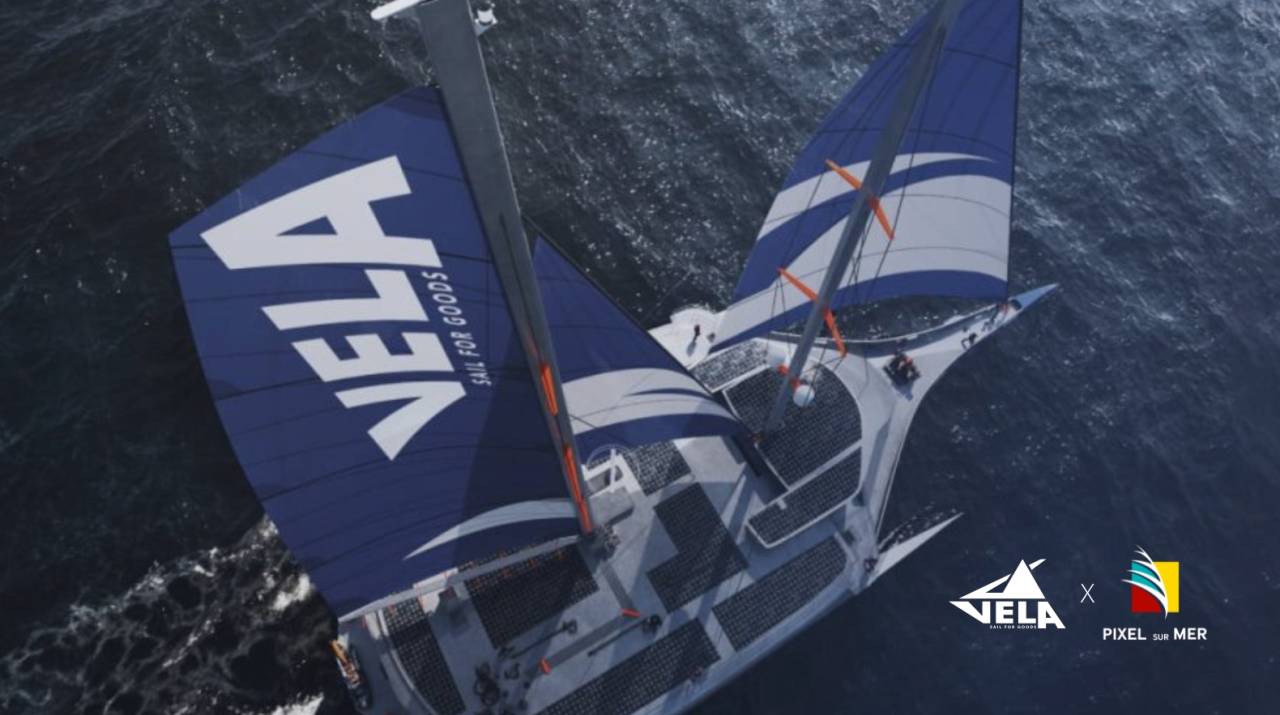
Measuring 67 meters in length and 25 meters in beam, featuring 1,552 m² of sail area, solar panels and hydrogenerators, Vela’s trimaran is designed to transport 600 pallets while ensuring speed, stability and outstanding energy performance.
Its distinctive feature: it carries pallets rather than containers, enabling a more flexible, faster approach better aligned with the needs of demanding sectors such as pharmaceuticals, luxury goods, wines & spirits, fashion and industry.
Designed by VPLP and MerConcept, the vessel is part of a deliberate French-led initiative, leveraging the offshore racing ecosystem to shape the future of maritime freight transport.
Why Pixel sur Mer
Operating a fully wind-powered cargo vessel with a commercial crew requires far more than an innovative hull and sail plan.
It demands a system that is simple, highly automated, and capable of securing, structuring and optimizing performance at every moment.
Vela selected Pixel sur Mer for its expertise in onboard electronics, instrumentation and system automation ; technologies that are proven in high-performance sailing and directly transferable to decarbonized shipping
Our Role
Securing, simplifying and maximizing performance at sea.
- Delivering a clear and actionable view of vessel performance
With the integration of Exocet Blue, the crew benefits from a centralized dashboard highlighting key information: vessel behavior, sail configuration and efficiency, rig load monitoring and performance trends.
This visibility supports informed decision-making and enables the crew to fully exploit the trimaran’s potential, even in complex conditions.
Objective: transform data into an operational advantage.
- Structuring maneuvers to ensure safety and performance
Pixel sur Mer supports the crew in managing and sequencing automated maneuvers.
Well-controlled maneuvers directly translate into gains in speed, onboard energy consumption and overall vessel reliability.
Objective: make every action smoother, repeatable and more efficient.
- Creating a continuous link between sea and shore
Data collected at sea is transmitted ashore to support analysis, predictive maintenance and continuous improvement.
This learning loop allows performance to be refined over successive rotations and maximizes the vessel’s operational availability.
- Onboard alert visualization
Exocet Blue centralizes critical alerts: threshold exceedances, detected anomalies or conditions requiring special attention.
Real-time visualization enables the crew to react immediately, secure maneuvers and optimize vessel performance, even in demanding situations.
A collaboration at the heart of shipping’s transformation
By leveraging experience gained in offshore racing, yachting, shipping and the wider maritime industry, Pixel sur Mer brings Vela a unique capability to industrialize wind propulsion.
Beyond the technical dimension, this partnership embodies a shared vision: making advanced technologies accessible, reliable and scalable, turning the decarbonization of maritime transport into a driver of performance and safety.
Together with Vela, Pixel sur Mer is contributing to the development of a 100% wind-powered cargo vessel capable of operating a fast, reliable transatlantic route with an exceptionally low carbon footprint.
An ambitious project, fully aligned with our shared mission: putting maritime innovation at the service of a sustainable future.