
Why is autopilot steering so demanding in offshore racing?
Offshore, the autopilot does most of the helming. It steers while the skipper handles manoeuvres, studies the weather, trims the sails or rests. It has to hold a course while wind and sea state change constantly, and every gust shifts the boat's balance. Steering quality therefore depends as much on how accurately the course is held as on how the rudder responds: corrections that come too late cost distance, while unnecessary rudder movements slow the boat down.
With each new generation, racing yachts become faster and more powerful, and skippers push them harder. Boats react more quickly to waves and gusts, and each one behaves differently: the autopilot has to keep pace and adapt to every boat. On multihulls, sailed ever closer to their limits, a poorly judged rudder command also puts both sailor and boat at risk. To support teams in this pursuit of performance, Pixel sur Mer designed its own autopilot, with control algorithms developed and owned in-house and built to evolve with the boats.
What is really happening on board?
The autopilot receives a target, either a heading or a wind angle, and continuously calculates the rudder commands needed to hold it. With Exocet Black Pilot, Pixel sur Mer controls this calculation end to end, using its own control laws rather than relying on a third-party manufacturer's algorithms.
The system combines two approaches. Correction brings the boat back on course when it drifts off. Anticipation prepares the rudder for changes in target, so the boat responds faster and more cleanly. The result for the skipper is more responsive steering with fewer unnecessary rudder movements.
The target itself is only as good as the wind data behind it. Exocet Silver, the navigation processor, calculates true wind and continuously checks that the sensors are consistent with one another, so the autopilot receives reliable information, even in the roughest conditions.
How do you keep control of the boat in demanding conditions?
In strong winds and heavy seas, the skipper expects the autopilot to hold the course and to keep the boat under control. Exocet Black Pilot's regulation functions take heel, boat speed and wind angles into account to adapt rudder commands to the sailing objective, whether that means going fast or protecting the boat.
The skipper starts from presets suited to each point of sail and wind range, then fine-tunes the autopilot's behaviour according to how the boat responds and how hard they want to push. Technical teams retain control over the advanced settings.
Because Pixel sur Mer develops and owns the architecture, the autopilot gains new control laws as testing progresses, drawing on sailing data and skipper feedback. Already installed on several boats competing in the 2026 Route du Rhum, Exocet Black Pilot is getting its first major exposure in a race.
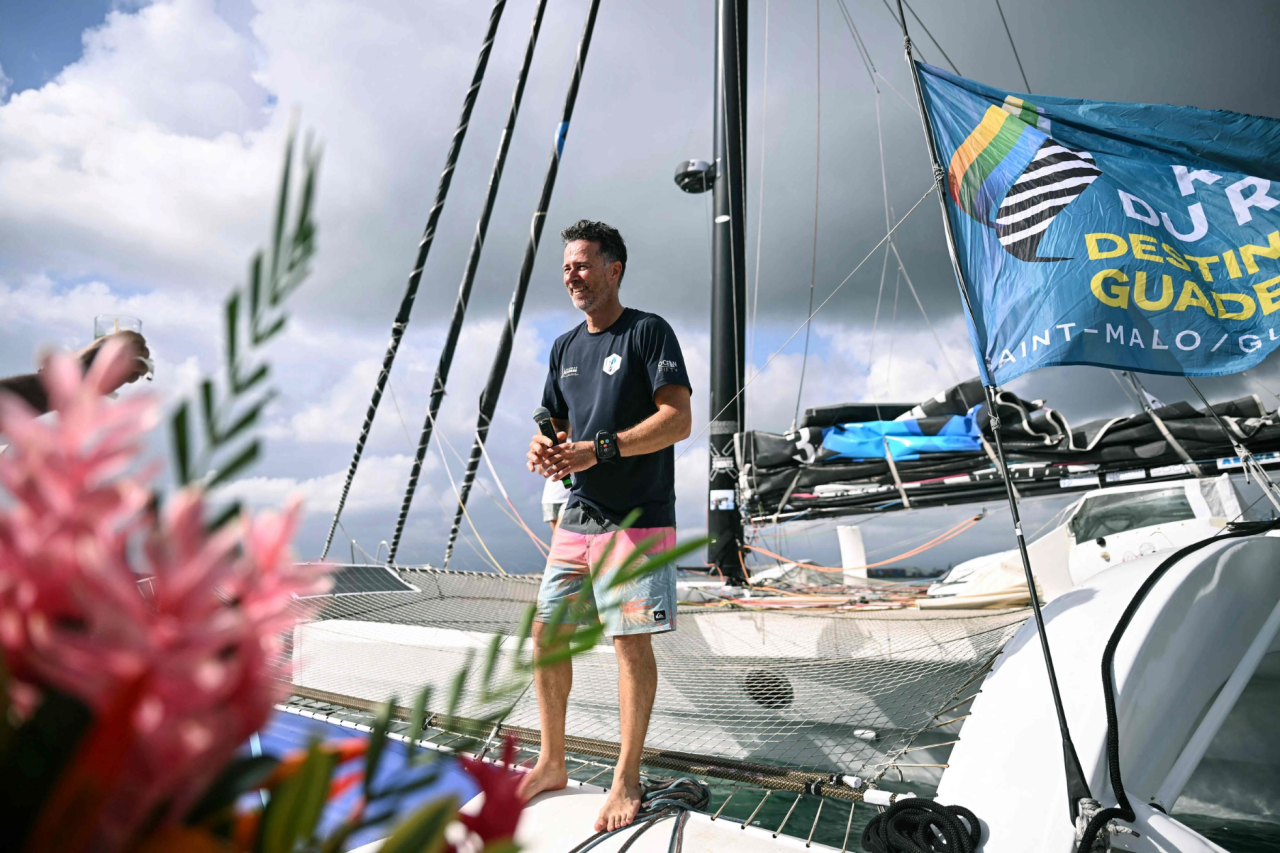
Aboard La French Fab with Laurent Bourguès
Laurent Bourguès is racing the 2026 Route du Rhum in the Ocean Fifty class aboard La French Fab, one of the oldest trimarans in the fleet, launched in 2009. For him, the autopilot is a crew member in its own right:
On a transatlantic, the autopilot steers 98% of the time. You take the helm for a few seconds to feel the boat's balance, and as soon as you can rest or work on the navigation, you hand it back. It's what you rely on.
On a multihull, that trust shapes the way the skipper sails the boat.
These are powerful boats that can capsize, and we're pushing them closer and closer to the limit. You need an autopilot you trust completely to react to a wave or a gust,
he explains. The heel safety function gives him an extra margin:
Mentally, it's a huge plus. Either I use it to take the stress off, or to push a notch further.
Up against newer boats, Laurent Bourguès also sees it as a way to gain performance:
I have one of the oldest boats in the fleet. With this autopilot, I'm hoping to step up a level and close the gap on the leaders.
Note: Laurent Bourguès crossed the finish line of the 2026 Route du Rhum in Pointe-à-Pitre on 12 November, after 11 days and 24 minutes of racing. In his first Route du Rhum, he finished 8th in the Ocean Fifty class.