
What is really happening in the sails?
Under load, a sail never holds the same shape for long. Wind, rig tension, mast bend and every trim adjustment made on board all affect it, and these factors interact to change its aerodynamic behaviour.
Until now, skippers have judged sail shape mainly by eye, drawing on their experience. A boat can reach excellent speeds without the team knowing exactly which sail configuration produced them, which makes that performance difficult to find again in similar conditions.
Without objective measurement, comparing configurations, identifying the settings that genuinely work and repeating them remains largely a matter of judgement. Pixel sur Mer and MDS developed Exocet FlyingShape to fill that gap, turning sail shape into data the crew can use on board.
Measuring how sails actually deform
Exocet FlyingShape scans the sail in 3D using LiDAR sensors. Because the sensors emit their own light, they work just as well at night as during the day.
At three heights on the sail, the system calculates two parameters that largely determine its power: camber, which is the depth of the sail, and twist, which is the change in its angle from foot to head.
Cross-referenced with wind and boat speed data, these measurements link each sail configuration to the performance it delivers. The team can see which shapes go with the boat accelerating and which coincide with a drop in speed.
Sail shape is no longer something judged by eye alone. It becomes data the team can measure, review and compare.
Sail trim: what does the data tell us?
Measurements recorded during training sessions gradually build up into a reference database. For each point of sail, wind strength and wind angle, the team can identify the sail shapes that deliver the best speeds.
These configurations are then compared and confirmed over the following sessions to establish target settings. The aim is a set of reliable references, built on the conditions the boat has actually sailed in.
On board, the skipper sees in real time how the measured shape differs from the target. This gives them additional information to understand what the sail is doing and adjust the trim to close the gap.
During a race, the skipper can return to configurations that have already proved themselves. Between sessions, the team uses the database to compare performance and build on the work done in training.
Performance work now rests on measured, comparable sail shapes, alongside the sailor's own experience and feel.
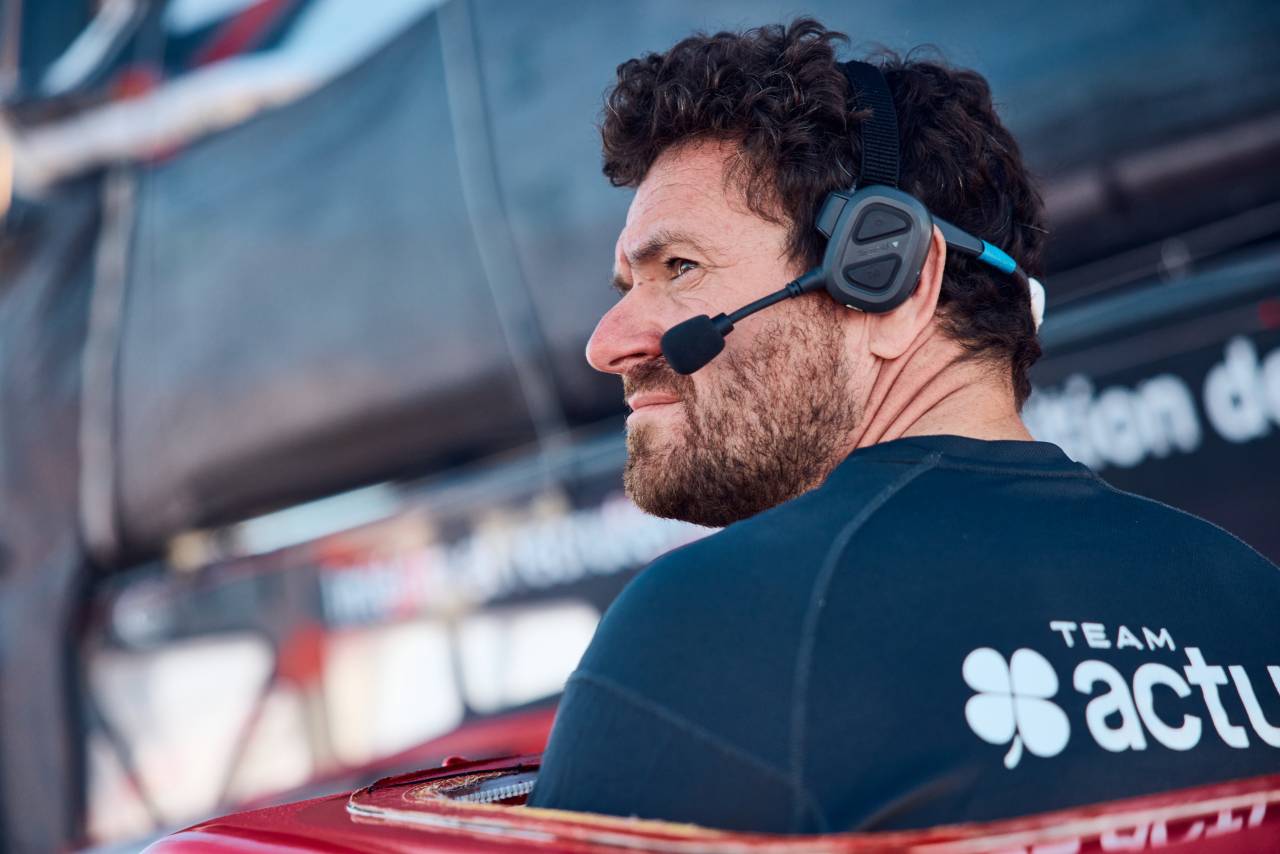
Aboard Actual Ultim 4
This season, Team Actual, Pixel sur Mer's technology partner, fitted its trimaran with a new mast and an entirely new sail wardrobe. Exocet FlyingShape adds to the boat's existing measurement system, which already brings together wind, speed and load data.
For Yves Le Blévec, Team Manager of Team Actual, the technology fills a gap in performance monitoring:
We measure everything on this boat. Every part we build is fitted with strain gauges. But for the sails, until now, we had no real way of checking that they matched what the sail designer had drawn.
The next step is to build a library of settings tailored to the trimaran's behaviour. Ultimately, Anthony Marchand, skipper of Actual Ultim 4, will have a dedicated sail interface with target configurations established and validated in training.
For a given point of sail, wind strength and angle, we'll know what the target setting is. In a race, you set up on the validated setting and then you sail by feel," says Yves Le Blévec.
Note: During the 2026 Route du Rhum, Anthony Marchand was forced to stop on 2 November, around 400 miles off the tip of Brittany, after Actual Ultim 4's central rudder struck an unidentified floating object. Following two days of assessment in Galway, the skipper and Team Actual decided to withdraw from this edition of the Route du Rhum – Destination Guadeloupe.