
How does the skipper stay in control when their attention is elsewhere?
It starts with centralisation. On a racing yacht, safety information is often spread across several pieces of equipment, each with its own alarm. Designed by Pixel sur Mer from its experience of onboard systems in offshore racing, Exocet Safety brings all alerts together in a single unit: man overboard, heel monitoring and capsize prevention, rig monitoring, water ingress detection, power consumption, weather monitoring and anchor watch.
For the skipper, this changes how they keep control of the boat. Wherever they are on board, a single source tells them what is happening, through an audible alarm or a voice message that identifies the problem. They also choose which functions to activate, depending on their boat and sailing programme.
How can risk situations on board be monitored more effectively?
Exocet Safety continuously cross-references data from the navigation processor with data from attitude, load and water ingress sensors. Each risk is tracked through several measurements: the boat's heel and pitch, rig loads, water on board, battery status, wind trends and the boat's position, which is used for man overboard and anchor watch. The system can also integrate alarms from other onboard equipment.
These values are compared against thresholds the skipper sets according to their boat, point of sail and how hard they are pushing. A trimaran sailing downwind in a breeze has different limits from one sailing upwind in a heavy sea, and monitoring adapts to those differences. As soon as a value approaches a threshold, the skipper is alerted and can decide what action to take.
What happens when the situation calls for action?
On a multihull, a gust can lift a hull in seconds. Exocet Safety can then act according to graduated scenarios the skipper has defined in advance. As heel increases, an alarm sounds first. If it keeps increasing, the system sends a course correction to the autopilot to depower the boat. As a last resort, it automatically eases the sheets.
Every action is optional and configurable. The skipper decides what the system is allowed to do, under what conditions and from which threshold. They delegate part of the monitoring without handing over control of the boat.
Aboard Damien Seguin's ORMA 60
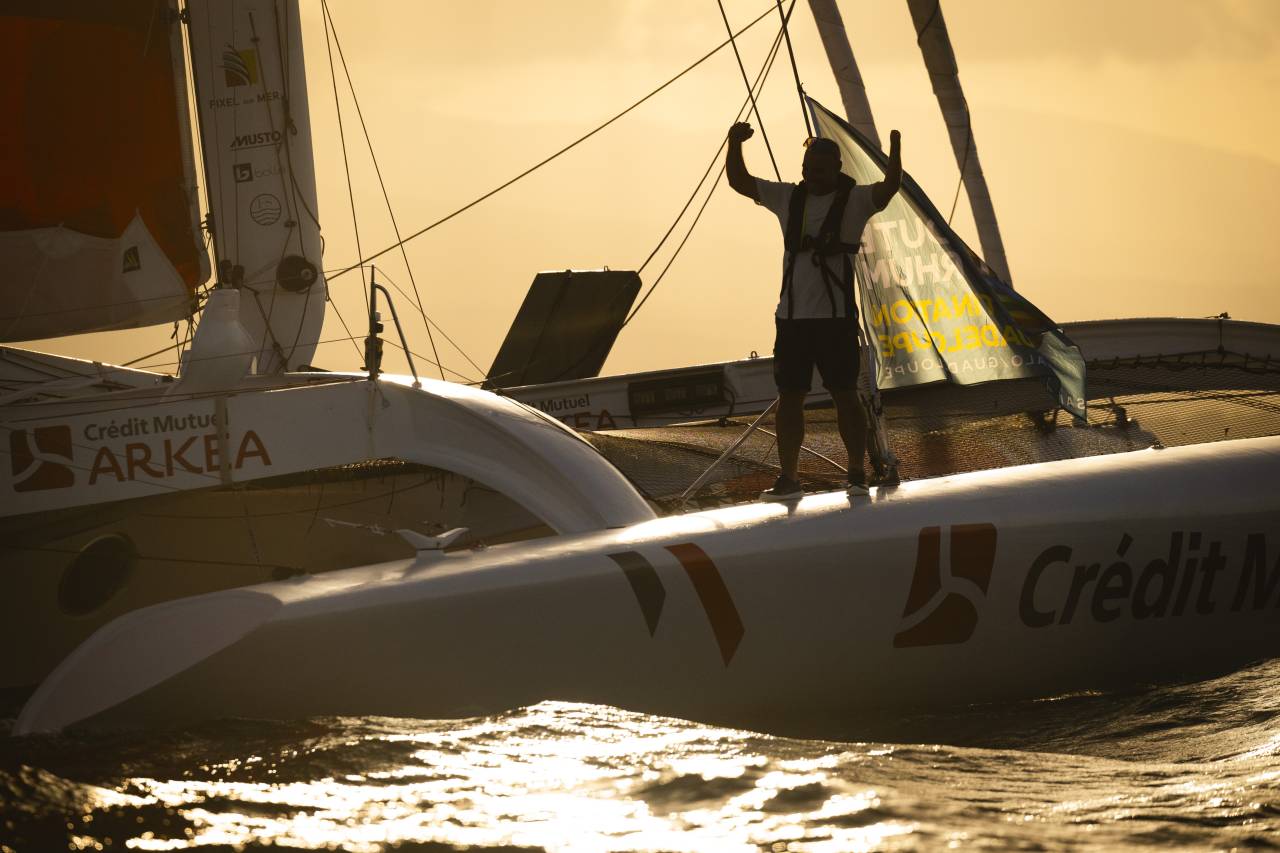
Damien Seguin is sailing the 2026 Route du Rhum solo aboard an ORMA 60, the former Fujicolor II, a trimaran that has raced the event since 1990. On this boat, safety was his priority:
Safety is central to the way I sail. I needed a system that went further than anything I'd already tried on the market, especially on trimarans.
Exocet Safety was fully adapted to his boat and his requirements, then tested and fine-tuned during training sessions.
Capsize prevention is at the heart of his installation.
A multihull is more stable upside down than the right way up. These are very powerful boats, and when you're sailing solo you need a system that handles capsize prevention and anticipates how the boat is going to move,
he explains. The scenarios were set up across autopilot action, alarms and easing the sheets, which he sees as the last resort.
This level of safety also changes the way he sails the boat.
Whatever the conditions, I can go inside, cook, rest or work on the weather without having to cut the boat's performance right back,
says Damien Seguin. He measures this against his trimaran's history:
This boat has been doing the Route du Rhum since 1990. Back then, they knew how to cross the Atlantic solo, but performance was compromised for safety reasons. Today, we'll be able to go faster on the same boats.
Damien Seguin is careful to make the distinction:
I wouldn't say I'm taking more risks. I'll be compromising the boat's performance less, and sailing in a way that's closer to what we know in the IMOCA class, but with the characteristics of a trimaran, which can bury a bow or lift a hull more easily.
Note: After 11 days and 8 hours alone at sea, Damien Seguin won the Vintage Multi class of the 2026 Route du Rhum. In his fifth Route du Rhum and his first in a trimaran, he brought back to Pointe-à-Pitre the boat he had watched arrive in 1990, at the age of ten. Along the way, he improved on the times set aboard the same boat by Mike Birch and Loïck Peyron.